FIRST THROUGH THE DOOR
Featured at the 2026 Canadian CBRNE & Robotics Summit · Instructors: Steve Clark · April 21, 2026
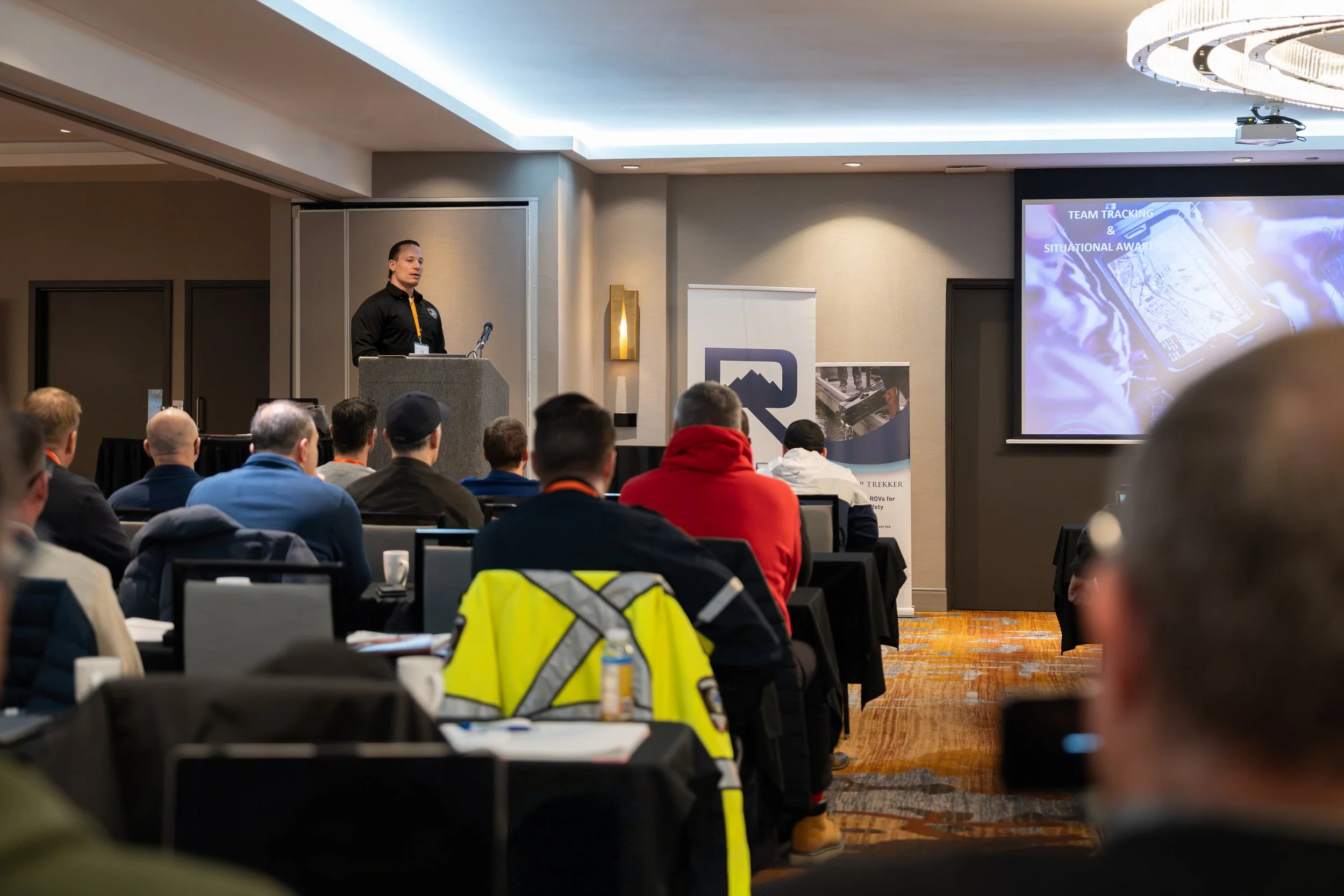
On a chemical call, the most dangerous minutes are the first ones.
Photograph by DIGRUCC.IO at the 2026 Canadian CBRNE & Robotics Summit
The best tool on a hazmat call might be the one that goes in so you don't have to.
On a chemical call, the most dangerous minutes are the first ones — the size-up, the walk to read the placard, the "what are we even dealing with." That's exactly the window a drone or ground robot now owns. It reads the placard from a standoff, sizes the spill, tracks which way the plume is drifting, and can hand command an exclusion zone before a boot crosses the line.
Here's the number that should sit uncomfortably:
only about 9% of US fire departments fly drones at all — out of more than 27,000 in the national registry. Most crews are still taking that first look with their own eyes and their own lungs.
What people don't realize the tech already does:
A drone can put all four sides and the roof in front of command inside two minutes of arrival. Gas-sensor payloads read the atmosphere inside a vapor cloud without a tech in the cloud. Some systems will auto-identify a hazmat placard, estimate the container or spill size, cross-reference the DOT and NIOSH guides, and recommend an exclusion zone off the wind — before you've finished donning.
Ground robots cover the entries you shouldn't make at all.
In a single May 2025 snapshot, US Homeland Security counted 17 emergency-response ground vehicles running hazmat operations with integrated CBRN sensors, and the whole robotics market is being pushed by teams swapping manual entry for remote inspection. The military is further down this road again — autonomous CBRN-mapping drones that fly a plume beyond line of sight and keep mapping through GPS and comms loss. What's frontier for them tends to land in the civilian hazmat world a few years later.
A few things worth keeping straight, though:
It's intelligence, not suppression. A drone is eyes, not a hose. It buys you a picture and a plan, not a knockdown.
It doesn't decon itself. Anything that flew the plume is now contaminated and comes back through your line. Treat the airframe like any other exposed tool.
The pilot is a trained position. Wind and structures kill signal, batteries run short, and the footage is evidence — chain of custody like a body cam, not a hobby clip.
None of this is about the gadget.
It's that the riskiest look on the call can now be taken by something you can replace. If your service is in the 91% without a program, that's the gap — and it's the cheapest one on this list to close.
Sources
~9% of US fire departments fly drones; 27,000+ in registry; "eyes not hoses"; four-sides-and-roof within two minutes — Drone Launch Academy (2026): https://dronelaunchacademy.com/resources/firefighting-drones/
Gas-detection drones assessing toxic environments without exposing personnel — DSLRPros (Feb 2025): https://www.dslrpros.com/blogs/rescue-drones/how-fire-departments-are-integrating-drones-into-their-operations
Plume tracking (direction, density, spread), standoff source/placard identification, chain-of-custody for footage — ZenaDrone (Feb 2026): https://www.zenadrone.com/fire-department-drones/
Auto-identifying placards, estimating spill size, cross-referencing NIOSH/DOT, recommending wind-based exclusion zones — US Patent 11,995,999 (drone first-responder assistance): https://image-ppubs.uspto.gov/dirsearch-public/print/downloadPdf/11995999
17 emergency-response ground vehicles with CBRN/hazmat sensors (DHS, May 2025); market driven by remote inspection replacing manual entry — Future Market Insights (Jul 2026): https://www.futuremarketinsights.com/reports/cbrn-and-hazmat-response-robots-market
Autonomous CBRN hazard-mapping UAS operating beyond line of sight through GPS/comms loss — US Army (Dec 2025): https://www.army.mil/article/289761/autonomy_in_action_advancing_cbrn_defense_capabilities_with_unmanned_systems
